CLINICAL HYPNOTHERAPY | NEUROSCIENCE
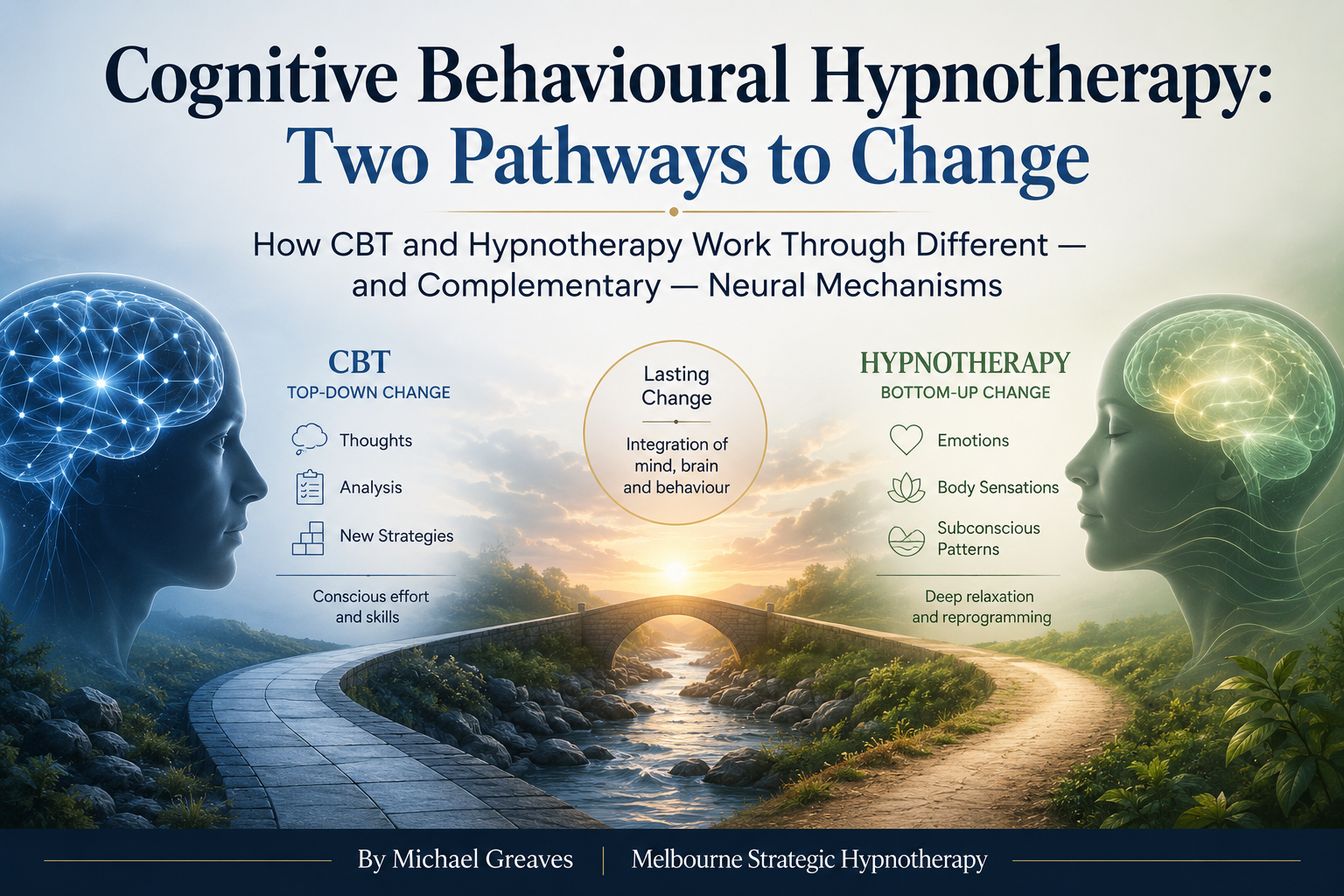
Cognitive Behavioural Hypnotherapy: Two Pathways to Change
How CBT and Hypnotherapy Work Through Different — and Complementary — Neural Mechanisms
By Michael Greaves | Melbourne Strategic Hypnotherapy
Introduction
Cognitive Behavioural Hypnotherapy (CBH) is an evidence-based integrative model that combines Cognitive Behavioural Therapy (CBT) with clinical hypnosis.
While both components share a common goal — helping individuals identify and modify unhelpful patterns of thinking, feeling, and behaving — they achieve this through fundamentally distinct neurological pathways.
Understanding how each component works at a neurobiological level helps explain why their integration is more powerful than either treatment alone.
As reviewed in IntechOpen's chapter on Cognitive Hypnotherapy (2020), CBH is an assimilative therapy rooted in the cognitive and behavioural traditions, with hypnosis added to target the unconscious, automated processes that CBT alone can struggle to reach.
This distinction — conscious versus unconscious processing — lies at the heart of why the two components operate differently.
The CBT Component: Top-Down, Cortical, and Deliberate
CBT works primarily through conscious cognitive restructuring — a deliberate, effortful process by which a person learns to identify and challenge maladaptive thought patterns and replace them with more adaptive ones.
Neurologically, this involves top-down regulation: the cortex imposing control over subcortical emotional responses.
Neuroimaging research has consistently shown that CBT's primary site of action is the prefrontal cortex (PFC), particularly the dorsolateral prefrontal cortex (DLPFC) and ventrolateral prefrontal cortex (VLPFC).
Key insight: CBT reaches the thinking brain — but some patterns live deeper, in systems that conscious thought cannot easily access.
The Hypnotherapy Component: Bottom-Up, Subcortical, and Implicit
Hypnosis targets a very different neural terrain. While CBT works primarily at the cortical level, hypnotherapy operates through bottom-up mechanisms, engaging subcortical structures and the autonomic nervous system in ways that are not easily accessible during ordinary conscious processing.
A comprehensive review published in Brain Sciences (2024) found that hypnosis modulates functional connectivity across a range of subcortical regions, including the thalamus, basal ganglia, brainstem, and anterior cingulate cortex.
The Vagus Nerve and Autonomic Regulation
One of the most clinically significant aspects of hypnosis is its action on the autonomic nervous system (ANS) via the vagus nerve.
Research has shown that hypnosis significantly reduces sympathetic nervous system activity and increases parasympathetic (vagal) tone, shifting the autonomic balance toward rest, safety, and recovery.
The Synergistic Effect: Why Integration Outperforms Either Alone
The clinical case for CBH rests on a substantial and growing evidence base demonstrating that integrating both approaches produces outcomes superior to either alone.
The landmark meta-analysis by Kirsch et al. (1995) pooled data from 18 controlled studies involving 577 participants comparing CBH with CBT alone.
The results showed that the average client receiving cognitive-behavioural hypnotherapy showed greater improvement than approximately 70% of those receiving CBT alone.
Conclusion
Cognitive Behavioural Hypnotherapy represents one of the most neurologically coherent integrations in modern psychotherapy.
CBT works through the brain's cortical, deliberate, and conscious systems to build better cognitive habits; hypnotherapy works through the body's subcortical, autonomic, and implicit systems to release and reprogram deeply embedded patterns.
Key References
De Pascalis, V. (2024). Brain Functional Correlates of Resting Hypnosis and Hypnotizability: A Review.
Wolf, T.G. & Halsband, U. (2022). Functional Changes in Brain Activity Using Hypnosis: A Systematic Review.
Seminowicz, D.A. et al. (2013). Cognitive-Behavioral Therapy Increases Prefrontal Cortex Gray Matter in Patients with Chronic Pain.
Kirsch, I. et al. (1995). The Comparative Efficacy of Cognitive-Behavioural Hypnotherapy vs. CBT.
De Pascalis, V. (2024). Brain Functional Correlates of Resting Hypnosis and Hypnotizability: A Review. Brain Sciences, 14(2), 115. doi:10.3390/brainsci14020115
De Benedittis, G. (2024). Hypnotic Modulation of Autonomic Nervous System (ANS) Activity. PMC/Brain Sciences.
Wolf, T.G. & Halsband, U. (2022). Functional Changes in Brain Activity Using Hypnosis: A Systematic Review. Brain Sciences, 12(1), 108. doi:10.3390/brainsci12010108
Seminowicz, D.A. et al. (2013). Cognitive-Behavioral Therapy Increases Prefrontal Cortex Gray Matter in Patients with Chronic Pain. The Journal of Pain. doi:10.1016/j.jpain.2013.07.020
Shu, I. et al. (2022). Neural Effects of Cognitive Behavioral Therapy in Psychiatric Disorders: A Systematic Review and ALE Meta-Analysis. Frontiers in Psychology, 13, 853804.
Kirsch, I. et al. (1995). The Comparative Efficacy of Cognitive-Behavioural Hypnotherapy vs. CBT. Meta-analysis of 18 controlled studies.
Ramondo, N. et al. (2021). Clinical Hypnosis as an Adjunct to Cognitive Behaviour Therapy. Meta-analysis of 48 RCTs, University of Western Australia.
Greenway et al. (2024). Cognitive Behavioral Therapy and Hypnosis in the Treatment of Major Depressive Disorder. International Journal of Clinical and Experimental Hypnosis, 72, 229–253.
Faymonville, M.E. et al. (2014). Neurophysiology of Hypnosis. PubMed. PMID: 25306075
Alladin, A. (2012). Cognitive Hypnotherapy for Anxiety Disorders. PubMed. PMID: 22655330