CLINICAL HYPNOTHERAPY | ADDICTION | CBH
Why Gambling Addiction Isn't About Willpower
I came across a Reddit thread recently titled "What's the worst gambling addiction story you've ever heard?" Reading through the stories people shared there, the secrecy, the mounting justifications, the sense that just one more win will fix everything, it reminded me of a man I knew. His story has stayed with me.
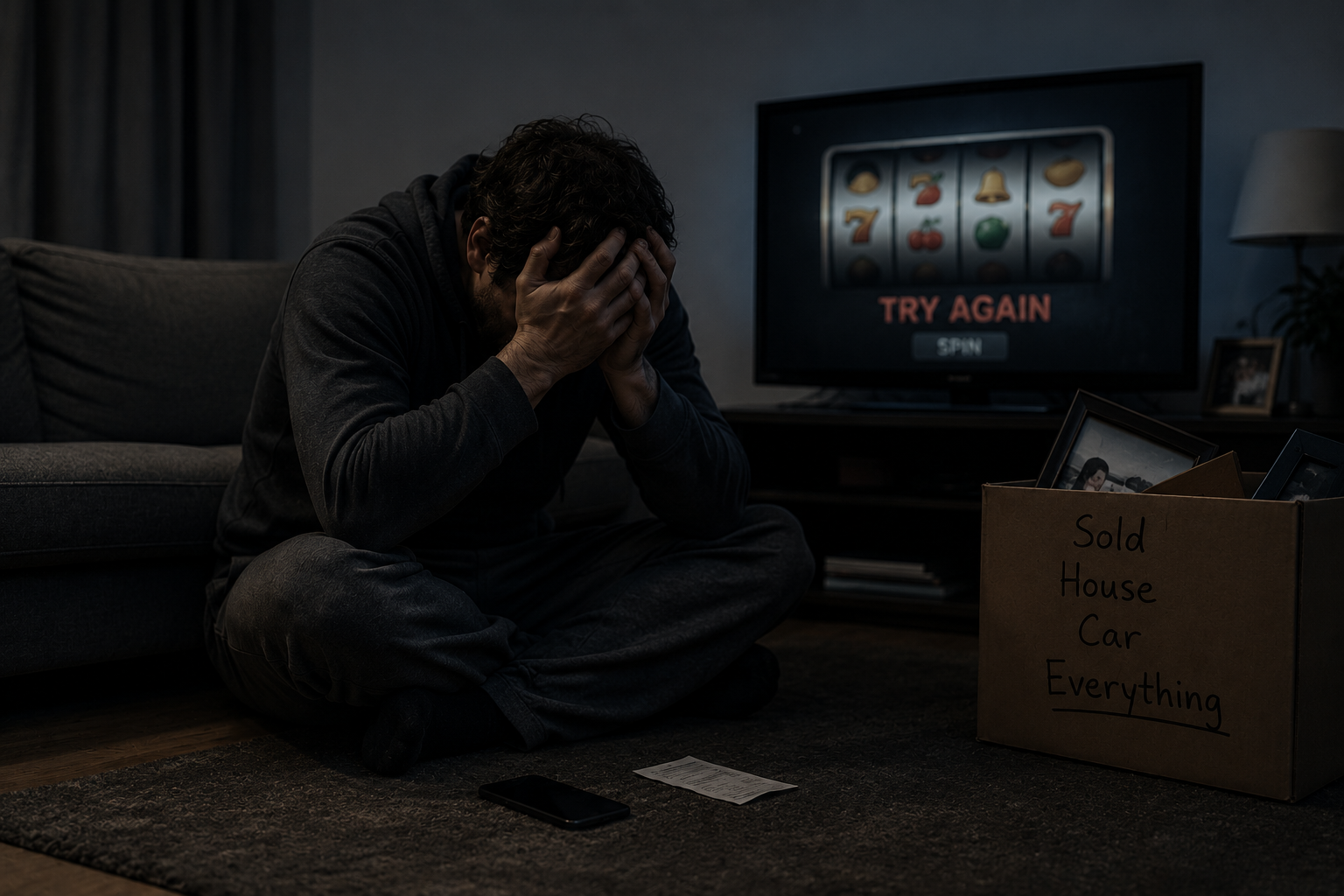
I knew a man, let's call him Jim. He held a good job, had a loving wife and a family, owned his own home, and was surrounded by family and friends. For a long stretch of the years Jim was in our lives, nothing much seemed to change for him, not from outside appearances anyway. Then Jim's world came crashing down around his ears.
He had been secretly borrowing money against the family home, and on a regular basis putting that money through the poker machines at a distant venue. Jim believed that as long as he could service the loans, everything would be fine and nobody would find out. He'd factored in a buffer for interest rate movements. He knew that if it came to it, his wife's parents were comfortable enough to help.
The reckoning came sooner than he was prepared for. He had overestimated how many times he could call on his in laws' generosity, underestimated how far interest rates would move, overestimated the capital growth on the house, and never considered that his wife might fall ill and lose her own income. Then the bank called. The truth of the family's finances became clear to his wife, and years of lies came out in full daylight. The double mortgage was called in and the family lost the house.
His wife was so hurt by the deception that she came to feel the marriage had been built on a lie. She left him and took the family with her. She was fortunate that her parents were able to keep them off the street.
It became obvious that Jim hadn't only been gambling with money. He had been gambling on getting away with the deception, and the deeper he got, the bigger that second bet became.
I have carried Jim's story with me for a long time, because it captures something the outside view of gambling addiction almost never shows. From the street, nothing about Jim looked wrong. The job, the house, the family, all of it stayed intact right up until it wasn't. What was actually happening sat entirely underneath, in a stress and reward system that had quietly reorganised itself around risk. I want to explain what that reorganisation involves, and why a combined approach of Cognitive Behavioural Therapy and clinical hypnotherapy tends to help where willpower and secrecy have already failed.
The stress system gets caught up in it too
We tend to think of gambling as a dopamine problem, chasing the thrill of a win. That is part of the picture, but research on the body's stress response tells us something equally important. Studies measuring cortisol in people gambling in real casino settings found that problem gamblers show altered stress hormone responses compared with people who gamble socially and walk away unaffected (Meyer et al, 2004). Later research went further, finding that cortisol levels tend to run lower as gambling severity increases (Palermo et al, 2015). In other words, the more entrenched the pattern becomes, the flatter a person's baseline stress response tends to be.
Clinically, this matches what clients describe to me. Many say gambling is the only thing that makes them feel something. Ordinary life feels flat by comparison. That is not weakness. It reflects a stress system that has adapted to a repeated pattern of high arousal followed by crash, and now needs that spike just to feel normal.
There is also a direct link between stress hormones and the brain's reward circuitry. One study found that in pathological gamblers, higher cortisol levels were associated with an exaggerated response in the brain's reward centre specifically to money related cues, a pattern not seen in people without a gambling problem (Singer et al, 2014). This helps explain why cravings intensify during stressful periods, and why gambling cues such as an advertisement, a venue, or even a certain time of day can feel unusually pulling when someone is already under pressure. People carrying a secret like Jim's often describe every fresh financial worry becoming its own trigger to gamble again, a way of trying to outrun the very stress the debt created.
The brain has been trained, not broken
Broader reviews of the neuroscience describe gambling disorder as involving genuine changes in the brain's dopamine based learning system, changes that overlap considerably with what is seen in substance addiction (Balodis and Potenza, 2013; Pettorruso et al, 2019). Near misses, bonus rounds, and the unpredictable timing of wins all interact with this system in a way that keeps a person engaged well beyond what a purely rational assessment of the odds would support.
I find this framing useful for clients because it removes blame without removing responsibility. Your brain's learning system has been shaped by an environment specifically engineered to reward persistence. That is a pattern, and patterns that have been learned can be unlearned. This is the same principle of neuroplasticity that underpins the work I do with anxiety and habit change more broadly. The brain that learned the pattern is capable of learning a new one.
In my own clinical view, though, gambling addiction rarely stays a simple dopamine chase for long. It may start there, with an early win or the thrill of risk, but it tends to find its way into cracks that were already present, unresolved issues sitting beneath the surface long before the first bet was placed. As the gambling continues, it widens those cracks and agitates whatever was unsettled underneath. At the same time, the addiction starts to feed off that same unresolved material, drawing on it for its pull and its persistence. The two feed each other. This is not something a single study proves, but it is consistent with what has been observed in some of the psychodynamic literature on gambling, and it lines up with what I tend to see in the room. It also explains something the neuroscience alone does not, why the compulsion so often outlasts the original thrill or the original financial motive, and becomes tangled up with a person's deeper sense of who they are.
The stories we tell ourselves while playing
Alongside the biology sits a set of beliefs that keep people at the table or the screen. Research into the thinking patterns common in problem gambling describes several recurring cognitive distortions, the same kind of thinking traps that show up in anxiety and worry, just pointed at luck and risk instead. There is the belief that a win is due after a run of losses, even though each spin or hand is statistically independent. There is the sense that losses were almost wins, which keeps hope alive when the evidence points the other way. There is a belief in personal luck as something that can be controlled or willed into being, and a tendency to explain away losses while remembering wins in vivid detail (Toneatto, 1999).
Jim's story shows this same distortion playing out at a financial level rather than at the poker machine itself. He believed he could manage the risk if he just planned carefully enough, factoring in a buffer here and a comfortable in law there, the same way a gambler convinces themselves they have found a system. The illusion of control did not stop at the machine. It extended into how he saw his whole financial position, right up until reality overtook every buffer he had built.
None of this reflects poor intelligence. These are natural cognitive shortcuts that become distorted under the specific conditions gambling creates. Recognising them by name is often the first step toward loosening their grip, because a belief that has been named and examined has far less power than one running quietly in the background.
How CBT and hypnotherapy work together on this
In session, the Cognitive Behavioural side of the work focuses on identifying which of these distortions are active for a particular client, testing them against reality, and building practical strategies for the moments when urges peak. This might include planning ahead for high risk situations, understanding personal triggers, and developing alternative responses to boredom or stress that do not involve chasing a win. If you want a fuller picture of how these two strands work together in general, I've written about it in more depth in CBH: Two Pathways to Change.
The hypnotherapy component works at a different level. Because so much of the gambling pattern lives in automatic, subconscious associations between stress, arousal, and the act of playing, talking alone often is not enough to shift it. In a relaxed, focused state, we can work directly with those associations, calming an overactive stress response and building new automatic patterns around calm and control rather than chasing arousal through risk. Over time, this supports the conscious strategies from the CBT work so they feel natural rather than like a constant act of willpower.
This combination, addressing the stress response, retraining the learning system, and dismantling the beliefs that sustain the cycle, is why I approach gambling difficulties the same way I approach other patterns of habit and anxiety. The goal is not simply to stop a behaviour through effort. It is to help the nervous system and the mind learn a genuinely different pattern, one that does not need to be fought against every single day.
If you recognise yourself here
I still think about Jim, and about how often the pattern underneath a secret like his could have been named and worked with long before the debts became unpayable. If gambling has become something you feel controlled by rather than something you choose, it is worth understanding that this is a learned pattern involving real changes in stress and reward systems, not a failure of character. Patterns that have been learned can be changed.
At Melbourne Strategic Hypnotherapy I work with adults across Melbourne's bayside suburbs including Brighton, Caulfield North, St Kilda and Malvern. If gambling has become something you feel controlled by, I would welcome a conversation.
References: Meyer, G., Schwertfeger, J., et al. (2004). Neuroendocrine response to casino gambling in problem gamblers. Palermo, F., et al. (2015). Hypothalamic-pituitary-adrenal axis activity in patients with pathological gambling and internet use disorder. Psychiatry Research, 226(1), 97-102. Singer, B. F., et al. (2014). Endogenous cortisol levels are associated with an imbalanced striatal response to monetary versus erotic cues in pathological gamblers. Frontiers in Behavioral Neuroscience, 8, 83. Balodis, I., and Potenza, M. N. (2013). Neurobiology of gambling behaviors. Current Opinion in Neurobiology, 23, 1-7. Pettorruso, M., et al. (2019). Dopamine and Gambling Disorder: Prospects for Pharmacological and Neuromodulatory Treatments. Toneatto, T. (1999). Cognitive psychopathology of problem gambling. Substance Use and Misuse, 34(11), 1593-1604.
If you would like support from a practitioner who integrates Cognitive Behavioural Therapy with clinical hypnotherapy, Melbourne Strategic Hypnotherapy offers a complimentary 15-minute phone consultation. Visit www.1you.au or call 0412 694 720.